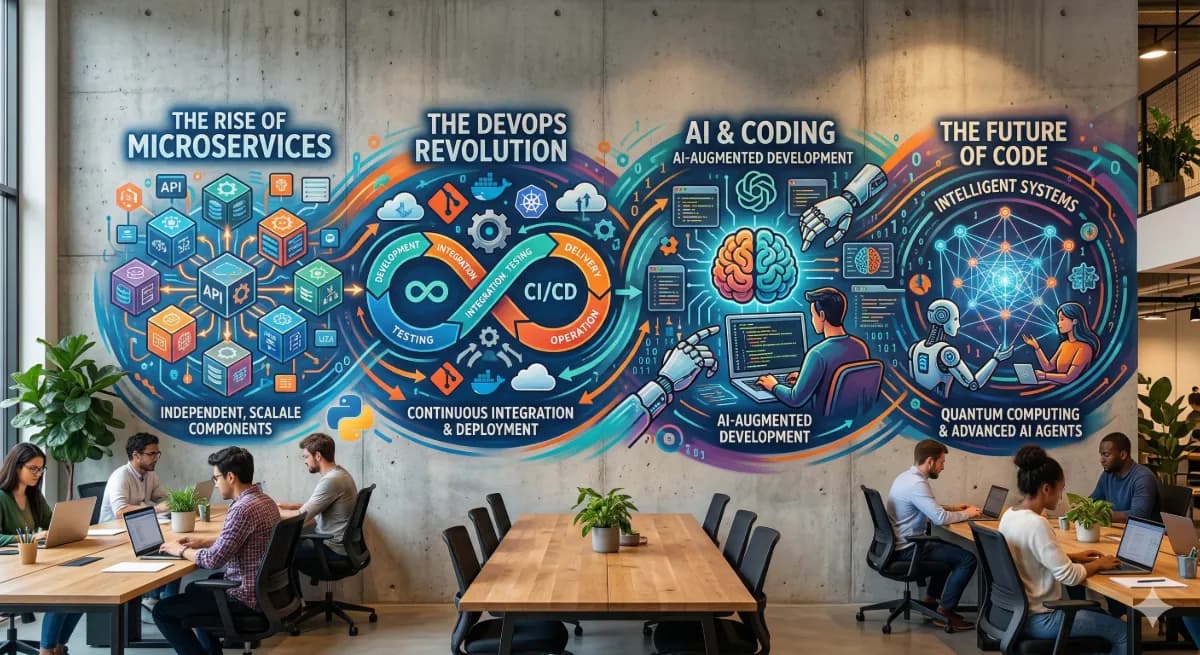
Modern Software Development: Patterns, Challenges, and the Future
The landscape of software engineering has undergone a radical transformation over the last decade. What was once a discipline focused on local installations and monolithic architectures has evolved into a complex ecosystem of distributed systems, cloud-native deployments, and artificial intelligence integration.
1. The Rise of Microservices
In the past, developers built applications as a single unit. While simple to deploy initially, these "monoliths" became difficult to scale. Today, the industry favors microservices architecture, where an application is composed of small, independent services that communicate over a network.
- Scalability: Individual components can be scaled based on demand.
- Resilience: A failure in one service doesn't necessarily take down the entire system.
- Tech Agility: Different teams can use different programming languages for different services.
2. The DevOps Revolution
The wall between developers and operations teams has crumbled. Through Continuous Integration and Continuous Deployment (CI/CD), software is now updated hundreds of times a day instead of once every few months. Tools like Docker and Kubernetes have made environment consistency a reality, allowing code to run the same way on a laptop as it does in a massive data center.
3. Artificial Intelligence and Coding
We are entering the era of "AI-augmented development." Large Language Models (LLMs) are not replacing programmers but are acting as powerful co-pilots. From generating boilerplate code to identifying complex security vulnerabilities, AI is significantly reducing the Time-to-Market (TTM) for new features.
Conclusion
Software development is no longer just about writing code; it is about managing complexity and delivering value quickly. As we look toward the future, the integration of Quantum Computing and even more advanced AI agents promises to redefine what is possible in the digital realm.
© 2026 Tech Insights Magazine | Built for the Future of Code